What “Normal” Actually Means on a Lab Report
And Why It Isn't the Same as Optimal
You've been there. You go to the doctor because something feels off — you're tired, foggy, gaining weight despite no real changes to your routine. Labs come back. The doctor says, “Everything looks normal.” And yet, you don't feel normal.
So what's actually going on?
The answer often comes down to one word: normal. Understanding what that word actually means on a lab report — and how different it is from optimal — is one of the most useful things you can learn about your own health.
The Problem With “Normal” Ranges
When a provider says your labs are “normal,” what they typically mean is that your result falls somewhere within a statistical reference range printed on the lab report. That range isn't a definition of health — it's a description of what's common in the population of people who get tested at that lab.
That's an important distinction. Common is not the same as healthy. If a large share of the people included in that reference range are dealing with poor sleep, chronic stress, nutrient deficiencies, or undiagnosed thyroid dysfunction, then "normal" ends up describing a population that includes a lot of people who don't feel great either — they just haven't been tested for the same things you have.
How Reference Ranges Are Actually Built
Reference ranges are usually built statistically: a lab takes the results from a large sample of people who were tested, and sets the "normal" range to cover roughly 95% of those results — typically defined as 2.5 standard deviations above and below the average. The remaining 5% fall "outside" the range and get flagged.
The catch is that this sample isn't a curated group of thriving, symptom-free individuals. It's simply everyone who happened to get that test — including people who are fatigued, stressed, under-treated, or somewhere on the early end of a condition that hasn't been formally diagnosed yet. Their results are baked into what counts as "normal" for everyone else.
That's how you can end up with a lab value that's technically inside the reference range, while still being far from where your body actually functions best.
Normal vs. Optimal: A Few Examples
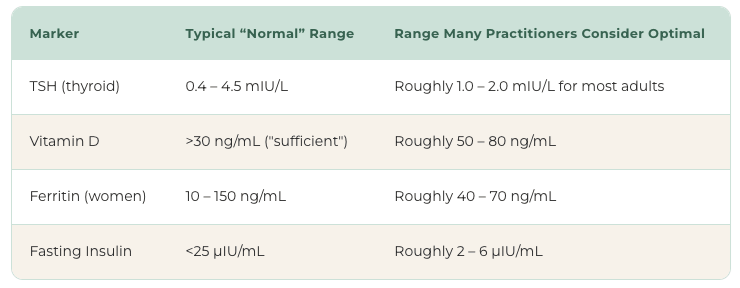
Here's how that gap can look in practice for a few commonly tested markers. These are general reference points often used in functional medicine — not a diagnosis, and not a substitute for your own provider's interpretation of your results.
These ranges are general educational reference points and vary by lab, age, sex, and individual context. They are not intended as medical advice — only your provider can interpret your results in the context of your full history.
Why This Matters for How You Feel
Consider TSH. A result of 4.0 mIU/L is technically inside most labs' reference range — but many people with TSH in that upper range experience classic low-thyroid symptoms: fatigue, weight gain, brain fog, cold intolerance, hair thinning. Meanwhile, someone with a TSH closer to 1.5 often feels noticeably better, even though both results would be reported as "normal."
The same pattern shows up with vitamin D. A level of 32 ng/mL is officially "sufficient" — but it's well below the range associated with optimal immune function, mood, and energy for many people. "Sufficient" was never meant to mean "ideal." It was meant to mean "not deficient enough to cause an obvious disease."
This is why so many people are told their labs are fine, and still feel anything but. The lab isn't lying — it's just answering a different question than the one you're actually asking.
What Age·Less Does Differently
This is the foundation of how we approach every Deep Dive Assessment. Instead of stopping at "is this number inside the reference range," we ask a different question: where does this number fall relative to the range where your body tends to function best — and how does that line up with what you're actually experiencing?
That shift in framing is often the difference between years of being told "everything looks fine" and finally getting a clear picture of what's been going on. From there, we build a personalized protocol — whether that's hormone optimization, peptide therapy, a longevity-focused lifestyle plan, or some combination — based on where you actually are, not just whether you cleared a statistical bar.
If you've been told your labs are normal but you don't feel like yourself, that's exactly the conversation we want to have.
Recent Posts
What “Normal” Actually Means on a Lab Report
Explore how functional medicine uses a deeper interpretation of bloodwork to identify root causes of symptoms.
What Is Peptide Therapy, and Who Is It For?
Discover what peptide therapy is, how it works, its potential benefits, and whether it's right for your health and wellness goals.