What Is Peptide Therapy, and Who Is It For?
If you've spent any time in wellness or longevity circles lately, you've probably heard the word peptides more times than you can count — on podcasts, in Instagram comments, maybe from a friend who's "feeling amazing" since starting a protocol they found online.
But what actually is a peptide? How do they work? And how do you tell the difference between a legitimate, provider-guided protocol and something you should be cautious about?
Here's a clear, no-hype breakdown.
What Exactly Is a Peptide?
A peptide is a short chain of amino acids — the building blocks of proteins. In fact, peptides and proteins are made of the same basic material; the main difference is length. Peptides are simply shorter chains, which often allows them to act more like signals than structures.
Your body already makes peptides constantly. Insulin, for example, is a peptide hormone. So is growth hormone. When people talk about "peptide therapy," they're usually referring to a specific group of peptides — beyond the ones your body already produces — that have been studied for their signaling effects on processes like tissue repair, recovery, and hormone release.
How Peptides Work in the Body
The easiest way to think about peptides is as messengers, not replacements. Rather than flooding your system with a substance and overriding your body's own processes, many peptides work by binding to specific receptors and prompting your body to do something it already knows how to do — just more effectively.
A useful example: instead of directly injecting synthetic growth hormone, a category of peptides called growth hormone secretagogues signal your pituitary gland to release more of your own growth hormone, in a pattern closer to how your body naturally does it. Other peptides, like BPC-157, have been studied for their potential role in supporting the body's tissue repair pathways.
This "signal, not replace" framing is part of why peptide therapy gets discussed differently than, say, anabolic steroids — though it's still something that should be approached with real clinical guidance, not guesswork.
Common Categories of Peptides
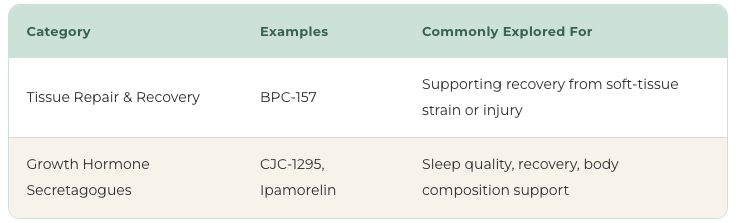
This table is for general education only. It is not a recommendation for any specific peptide — the right protocol (if any) depends entirely on your labs, history, and goals, and should be determined with a qualified provider.
Who Tends to Benefit From Peptide Therapy
Peptide therapy isn't a single "treatment" — it's a category of tools that can be applied to a few different goals. People who tend to explore it include:
- Athletes and active adults whose recovery from training, injury, or surgery feels slower than it used to
- People whose sleep "looks fine" on paper but never feels restorative
- Those interested in longevity and proactive optimization — not waiting for something to feel broken
- People who've already looked into peptides on their own, but want a credentialed provider to guide the decision
Why “Where You Get It” Matters
One of the biggest risk factors in peptide therapy has nothing to do with the peptides themselves — it's the source. Peptides purchased through unregulated online sellers come with real uncertainty: unknown purity, inconsistent dosing, and zero clinical oversight if something doesn't feel right.
A provider-guided approach looks different. It starts with your labs and history, includes a conversation about what's actually appropriate for your goals, and continues with monitoring — so your protocol can be adjusted based on how you respond, not just how you hoped it would go.
How a Peptide Protocol Actually Starts
At Age·Less, peptide therapy never starts with a menu. It starts with an assessment — your labs, your history, and a real conversation about what you're trying to accomplish, whether that's recovery, sleep, or a longevity-focused plan. From there, if peptide therapy is appropriate, we discuss which options fit your specific situation, set a dosing and monitoring plan, and follow up to see how you're responding.
If you've been curious about peptides but didn't know where to start — or who to trust — that's exactly the conversation a discovery call is for.
Recent Posts
What “Normal” Actually Means on a Lab Report
Explore how functional medicine uses a deeper interpretation of bloodwork to identify root causes of symptoms.
What Is Peptide Therapy, and Who Is It For?
Discover what peptide therapy is, how it works, its potential benefits, and whether it's right for your health and wellness goals.